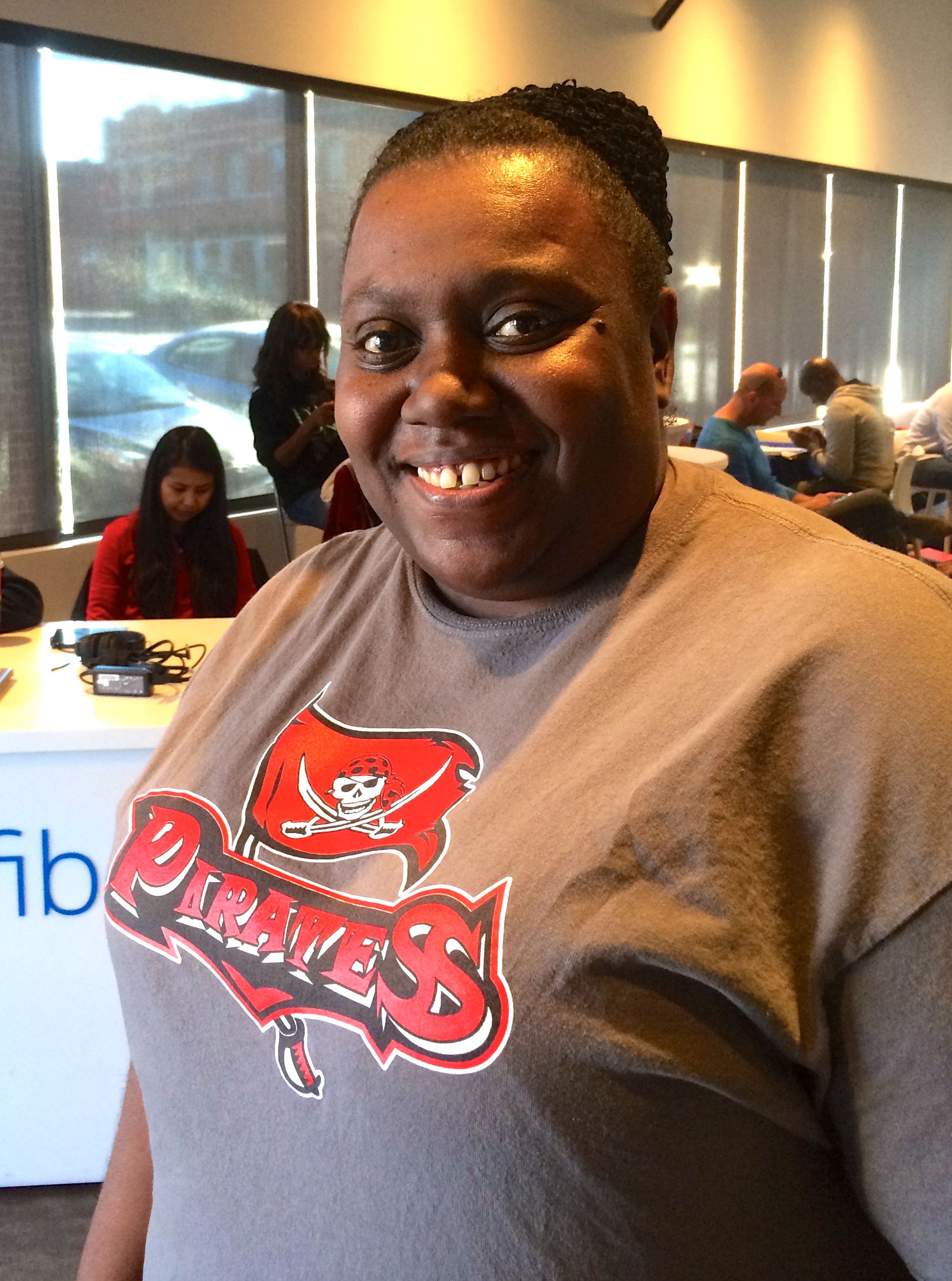
Shérry_Delich

Shérry Delich has been a thinker and a tinker her entire life. Her love for computers began with a general appreciation for engineering from an early age. Upon earning a bachelor of science in Electrical Engineering and Physics at the University of Missouri-Kansas City in 2003, Delich worked as a software developer at a variety of companies across the metropolitan region before joining VinSolutions two years ago.

In addition to mentoring for two years with CoderDojo, Delich is active as a volunteer with Girl Scouts, as her two older daughters are both Girl Scouts. She provides support for troops in the Northland area with cookie sales, day camp staff, and recruiting efforts.

1. How did your interest in coding begin?
It’s not just computers; it’s engineering in general. I came from a family of six kids, and I hung out with my older brother, who is seven years older. He loved working on small-gas engines and anything mechanical in nature. I kind of picked that up from him. I enjoy manufacturing things out of different things. I am really big into robotics; physics is what my actual major was in. There’s always been a solution to manufacturer what I need.

2. How has your technical knowledge transferred into other aspects of your life?
I see the overlap mostly when I volunteer for organizations that have no technology. With Girl Scouts, everything was a paper form – online- forming something takes me 20 seconds. You’ll see these different organizations that are stuck in the Stone Age, and I really do enjoy helping them out. It’s about baby steps and not overwhelming them, though. That’s just the way I teach my kids, too, with logical thinking. Instead of them saying, “I can’t do this” or “I can’t open this,” I ask them, “How do you think we should open this?” I do that a lot with my Girl Scouts, too.

3. What do you enjoy most about your work?
I’d have to say the flexibility. I have a lot of flexibility when it comes to my architecture. We have a set of architects that pretty much give us lead developers free reign. I get the opportunity to introduce different technologies that I want.

4. What are the more challenging aspects of your career?
It’s not so much now, but early on in my career, it was immediate distrust. Two people would get hired on at the same time, with the same background, and I felt like I had to reprove myself. I’m very forthcoming with my age now. I feel like I have to go in there >now and say, “I am 37 years old.” I felt I was doing well to not be noticed, and that has changed dramatically for me now.

5. What advice would you offer your younger self today, or to someone who is looking to shift careers into one that is more coding-based?
Really looking at yourself and decide why you are trying to do this. I find that a lot of younger women that I talk to these days are looking for a better income. This is not the way to do it. You have to have a true love for it. I love the fact that I can spend all day to find a problem, but a lot of people rip their hair out over it.

6. If you could tell the general public one thing about software engineers and what it means to write code, what would it be?
One, 90 percent of the stereotypes you hear about us being fueled off of Mountain Dew and beef jerky and Twizzlers is not true. We are not all the same. I find that to be one of the more frustrating things. And, it’s not just women: I’ve worked with men who also have found it to be the same.

7. How do you envision STEM evolving into our daily lives?
The STEM question is huge, especially with my kids: There is a huge push for STEM in schools, and there is a huge push for STEM in Girl Scouts. It’s one of the things that gets the recruiters going. The only thing I can really stress to people is that if your child does not want to do it, don’t cram it down their neck. We still need the artists and painters of the world; not everyone is going to be an engineer. You can’t force a kid into it, or they are going to learn to hate it.

-Adrianne DeWeese
Adrianne DeWeese is a Media Analyst-Account Coordinator for Synoptos Inc. A member of the KCWiT Marketing & Communications Committee since June 2016, she also enjoys pursuing a Master of Public Administration at the University of Missouri-Kansas City and serving as board chairwoman of Pages & Chapters, a Kansas City- and Washington, D.C.-based family literacy nonprofit organization. Adrianne is married to John Leacox, a dedicated software engineer, and she believes in equal educational rights for everyone and hopes that sharing the stories within KCWiT will inspire others to also pursue their dreams. 


Sometimes the most intimidating part of learning something new is taking that first step. After that, it just takes effort. Coding & Cocktails co-director Tamara Copple talks about one of the questions we hear often from our participants. 

Tamara“Tamara, how do you do it?” a Coding & Cocktails attendee asked me, frustrated at her own efforts to make discernible progress. She knows my story: how I heard about Kansas City Women in Technology while listening to public radio station KCUR on the way to work. How my developer husband told me I was “definitely” programmer material and should network with them. How I showed up to the very first Coding & Cocktails session as a participant, fell in love with KCWiT and within three sessions found that I was suddenly the program’s co-director, when I still couldn’t script my way out of a paper bag. She knows the spiel I give every time I present at Coding & Cocktails: “Nobody becomes a programmer by spending 3 hours a night, one night a month, while drinking. Nobody.”

Coding & Cocktails is about overcoming your inhibitions and self-doubt and trying something radically different. Despite the name, drinking alcohol is not required, but if a custom cocktail helps relax you enough to give it a try, we’re your show. If you discover programming is not your thing, that’s okay. Enjoy the drinks, enjoy the camaraderie, and pat yourself on the back for at least giving it a try. You’ve already done more than most.

On the other hand, if you discover you enjoy yourself at Coding & Cocktails and want to learn more, great! However, as with weight loss, yoga or going back to school, anything worth doing takes effort and practice, and eventually you must fully commit to the path to achieve the goal. Here are three things I have learned on my own journey.

First, know thyself. Know in your heart of hearts why you want to pursue programming. It takes a certain kind of thinker – not a mathematician, but a person who can think logically in steps and see patterns. One who enjoys building, and creating. One who really digs problem solving. Thanks to the plethora of free coding classes available online, just about anyone can learn the fundamentals but it takes a problem solver to get to the next level. I think in pictures and concepts, so algorithmic thinking is a learned behavior for me, but I persist because I like problem solving, and programming challenges me mentally in a way I enjoy.

Second, be accountable to yourself. As the program co-director, I have deliverables. I have a presentation to script in HTML, CSS and JavaScript. When I present a topic, I need to know what I’m talking about. When my partner Sarah asked, “Do you think you could push the presentation to the website this month?” I figured it out even though I had never touched the website code before. Trial by fire may not be necessary but you must carve out the time for learning and more importantly, practicing. If it takes the pressure of a deadline, so be it, you can always set one for yourself!

Finally, build your network. Be seen, be heard, and be active. Meetup has a nearly inexhaustible list of technical user groups. KCWiT specializes in connecting women who “want to be” with those who “are.” Talk to other women programmers, and make friends. We even have a Slack chat group for that very purpose. Letting people get to know you and your commitment makes them more willing to help you along your journey, and eventually even help you network into that life-changing job.

At Coding & Cocktails we provide a feminine, low-stress, non-judgmental environment for self-discovery. What happens next is up to you.


Coding & Cocktails wouldn’t be what it is without our fantastic mentors who volunteer their time to help other ladies learn how to code.  One of our Coding & Cocktails mentors, Heather, shared her perspective on the May Coding & Cocktails session on JavaScript using jQuery.

HeatherIn May, we introduced jQuery and JavaScript. This is by far one of my favorite languages to work with because of all the fun things you can do with it. JavaScript should not be confused with Java, because they are two very different things (Java is a programming language and JavaScript is a scripting language for one). This is also a language that I am still learning everything I can do with it. It is just that vast. When I started coding many moons ago building websites that would make you gasp, I used HTML and JavaScript. I thought they were “da bomb” because I had buttons that changed colors, cursors that changed when you hovered over a link, font that changed colors, and even scrolling text. It is now over 10 years since I created my first page and JavaScript still amazes me. With that said, it’s pretty clear that if you do not understand everything in one three-hour session, you are not alone.

JavaScript is a language that is used to make the user experience better, as well as provide a dynamic aspect to the site. It is an older language, actually celebrating it’s 21st birthday this year. Just like using CSS compilers can make things cleaner, using the jQuery library can help keep things streamlined.

As a mentor this month, we had a lot of people who were new and jumping in. This helped me go over the skills I learned a few months ago when I attended the Git session as a student. We went back into Github and cloned KCWiT’s repository, checked-out a new branch, and then worked on the files in Sublime Text.

From a mentor standpoint, it was great seeing ladies learning how to work with JavaScript because it is used almost everywhere, but definitely in front-end development. It is also a great place to take a pause and review everything we have covered so far. CSS, JavaScript, and version control are a couple of the key aspects when it comes to front-end development and are definitely things that take a while to learn (especially since I am still learning them with years of coding knowledge).

So what is my favorite part of this month’s lesson? Being able to use an in-browser debugger (I’m on a Windows computer so I just click F12, but it’s cmd+option+i on a Mac). I love having quick access to look at errors, see the various elements (that light up when you hover over the code), and see sources of different aspects. It makes working on a site just that much easier. I am looking forward to next month when we’ll get to review and catch-up before moving onto the next session and I hope to see everyone there learning alongside us!


One of our Coding & Cocktails LadyDevs, Tara, will be sharing her perspective on the Coding & Cocktails sessions with us over the next few months.  Here is what she had to say about the April session, which was an Introduction to CSS compilers.

.facebook_1456192944520

Precompiling CSS. I’ve spent a week trying to think of what to say about this, and, to be honest, I’m not sure. Tamara hit the nail on the head when she said we won’t get this all in one go. There’s a lot of information to absorb on this one, and it’s a lot to wrap your head around, but that’s what our Slack channel and mentors are there for! Honestly, this is probably what I’ll be working on in June when we take a “break” for review and further practice on the concepts we’ve already covered.

Compilers are new to me, and I know there are a lot out there for all sorts of different projects. I’m not sure how they all work. For this, we used Sass. I’m probably going to go over the slides a few more times to make sense of it all, but, from what I got working on it, you can create separate Sass files for variables and other elements of your styling and then compile that into a CSS file. This is a very high level concept of what goes on, but the idea is that, in big projects, you can make changes quickly and efficiently. It creates a cleaner, more manageable code. I spent an hour working on my CSS, because we were getting some CSS practice in too and my CSS skills are pretty weak. In that hour, I got about three lines completed and a few mentors stumped until we all realized my mistakes and then (Ta da!) working code. I originally thought that the CSS file was required before Sass files could be created and compiled, but I was mistaken; this was just something we did at Coding & Cocktails to give us some extra CSS practice (my CSS needs CPR) and to show us how a compiled file compares to a CSS stylesheet.

I can definitely see how it can make coding cleaner in the long run. There are some things I’m not quite sure I understand, but that’s what Coding & Cocktails is all about: working it out with women in the same boat. I’m hoping that some of this can be worked into modular development so that SASS files can be used in other programs with some minor changes to reduce the coding time, but I’m not sure if that’s possible…. Granted, a lot of development is using someone else’s code. Precompiling seemed like a lot of work with the additional CSS practice, but I look forward to the how much easier it’ll make coding in the future!


One of our Coding & Cocktails LadyDevs, Tara, will be sharing her perspective on the Coding & Cocktails sessions with us over the next few months.  Here is what she had to say about the March session on version control.

taraVersion control. It’s an easy enough concept to understand: a system of recording changes to a file so that specific changes can be recalled later.  There are several reasons this is important in development, and we used Git to learn how to create our own repositories and pull/push them between our laptops and the cloud. So, let’s Git on with it!

The command line made it’s comeback this month as we worked in Git Bash again. We pulled repositories down from GitHub onto our local machines, made updates,and pushed them back up to the GitHub. It’s surprisingly not as difficult as it sounds. Some of the more complicated concepts are forking and branching. Forking is when you copy someone’s repository to your own project, while branching sometimes involves working on a project with others, being able to make your changes separately from the released version of code and merging it back into the master branch.

Here I owe a big shout out to our mentors! I got lost several times along the way, and our mentors are always right there to help out. This was a quick paced Coding & Cocktails and went right until 9pm, so it was great to have the mentors right there when something didn’t work quite right. Coding & Cocktails makes sure you aren’t ever lost, and I’m very grateful for the work these ladies do to keep us learning!

The big take away I got from this session is the implications to modular development, where teams work on individual aspects of a project and merge it into a solid whole later, and peer review elements. GitHub is very important in both of these regards. Also, if the code doesn’t work for some reason and a prior version is needed, version control makes it easy to go back to the necessary version. All of these are important elements of development. This session gave a big overview of what life in the workplace will be like after graduation, so that’s greatly appreciated.


One of our Coding & Cocktails ladydevs, Tara, will be sharing her perspective on the Coding & Cocktails sessions with us over the next few months.  Here is what she had to say about the February session on the command line.

tara

This month’s Coding & Cocktails tackled the Command Line, or, as I lovingly grew up referring to it, “that place you must never go for fear of turning your computer into a paperweight forever”. That command prompt box terrified me. I was raised in a household where women weren’t allowed to play with computers beyond Microsoft Office and some games because “tech stuff wasn’t for girls”, so this session really challenged the concepts of what I was capable.

My terror was completely unfounded, and this month’s Coding & Cocktails put all those myths about the monster hiding in the computer to rest. I settled in with a stiff drink, because I KNEW I was going to need it… and proceeded to sort through directories and folders; create, move, rename, remove, and manipulate all sorts of files; and do the same things we do every day with mouse clicks and icons from the comfort of a keyboard and a few simple commands. That’s it. No magic. No ruined computer. No calling Geek Squad for help. Just me and a room full of women showing our computers who’s boss, which is rewarding because, sometimes, you kind of feel like the computer has the upper hand on you.

That’s one of the best things about Coding & Cocktails (well, besides the crazy delicious drinks): it doesn’t matter your level of expertise. You get to spend an evening learning how not to be dominated by your technology and learning how best to put it to use FOR you. It’s an empowering feeling, especially in this day and age when we like to attribute intelligence to our machines. Too often, we talk about our computers like they have a mind of their own and won’t do what we want. Coding & Cocktails reminds us that computers aren’t finicky kids throwing tantrums and gives us the tools we need to make them work for us: how to look in the right places, use the right commands and think in a way that the machine “understands.”

My whole way of thinking about how I interact with technology is slowly undergoing a pretty significant paradigm shift: I’m starting to reconsider how I interact with the technology I use on a daily basis, why and how it works like it does, and how to optimize its use for me. How can technology REALLY make me a better person? What does that even mean? These are some pretty hefty questions that are coming out of a night of drinking with the girls over a computer screen and some computer classes, but I’m in the process of reinventing and redefining my life by going into development after years working in healthcare. And I’m not the only one. I know several other women in Coding & Cocktails are experiencing the same transitions themselves. This is important stuff, and it starts with something as basic as learning how to manage the command line in an environment where we feel safe and comfortable to be ourselves. I won’t lie: the alcohol helps too.


What I do: 
Junior Computer Science major at Kansas State University.
What languages do you know?
C -sharp, HTML/CSS
What do you enjoy most about working as a mentor for CoderDojo?
It’s really cool to introduce kids to computer science. It’s a really inviting place for beginners and then also students who a more skilled.
As a computer science major, do you often see women in your classes?
There are some women in my classes but not very often, it’s not very diverse in that respect.
What is your impression of the technology ‘scene’ in Kansas City?
It’s great to have the Google Fiber Space which is awesome in itself. Also the KC Start Up Village is a great resource.
 What is your favorite music to listen to when you’re coding?
Anything that can get my head bopping. So hip-hop or anything like that.


Cassandra Nave_SpotlightWhat I do: 
“I work virtually with Fusion Apps Inc. We code online and focus on business development, project management, proconsul management.”
What is your technology background?: 
I began programming in school to Basic, Pascal, COBL, FORTRAN, and Assembler. I have programmed in many different languages, C, ProC, XML, CSS, SQL, whatever the applications needs. Now I have experience from Pre-Sales to Business Development to teaching classes and from backup support to managing software, networks, and disaster recovery (DR).
What do you enjoy most about working as a mentor for CoderDojo?
I love STEM initiatives. Our schools cannot give our kids all the learning during a regular school day so we have to supplement and keep their interests. 
How is technology impacting Kansas City?: 
Kansas City is different in the fact that we have technology widely available, but our school districts don’t full take advantage of it. So you have a really successful part of the population, but the ability to change to be successful is not fully accessible to all areas of the population. Bring technology to the masses and make it available. Make it available via schools, churches, and places like the Full Employment Council. 


HeatherBirdwell What do you enjoy the most about being a program mentor?

 “The excitement, watching kids get excited about coding. Some boys are coding      in  Minecraft command code, girls are working on a variety of projects, there’s very different aspects of activities that are going on.”

What is your technology background?

“I grew up with a computer engineer for a father, so it was a very technical environment. I created my first HTML website in 2000 and it’s still live.”

How did you get involved with KCWiT? 
My friend posted about CoderDoJoKC on Facebook and I knew I needed to get my kids involved. I saw they take mentors and I knew it was up my alley. The rest is history.
 
What is your favorite music to code/work to?

Lindsey Stirling Pandora Station

What is your favorite thing about Kansas City? 
It’s really such a small, tight-knit community even though it is a big city
 
Describe what you do in one sentence
I currently provide web content for clients, but am growing to create create websites, repair mobile devices, and offer social media marketing consultations.


Michelle Tuason

Describe what you do in one sentence.

My job title is Developer. As part of the Business Innovations team, I use technology in various forms to address the needs of our internal and external clients.

How did you get involved with KCWiT?

Initially I was referred to the CoderDojo program through a co-worker. After mentoring at one of the sessions, I got a chance to meet Jennifer (Wadella, KCWiT founder) and asked her how I could get more involved.

What is your technology background?

I started my technology career six years ago on the help desk of a law firm. My initial intent was to move into networking, but I became really passionate about programming after I was given the opportunity to build a new intranet site for the firm. My positions since then have all been focused on software engineering and development.

What is one thing you learned or a memorable experience from your time as a KCWiT mentor?

Even though my involvement so far has been as a mentor, I feel like I’m the one who learns the most after each event. Whether the audience is young or old, male or female, each of their unique perspectives continues to inspire and influence my professional and personal life.

Describe your dream cupcake.

Never-ending 🙂

If there were a TV show about your life, what would be its theme song?

“Unstoppable” by Santigold


Code of Conduct      Copyright 2023 © Kansas City Women in Technology